
Companies
The businesses behind the people you hold, grouped — and why a company with nobody behind it is not shown.
Last reviewed September 8, 2026
A company appears the moment an agent finds somebody who works there. There is nothing to create, and no way to add one by hand — it exists as long as you hold a person from it.
That is the whole idea: a second way of looking at the people you already have, grouped by where they work. It is a tab next to Leads rather than a section of its own, because nothing is done to a company. You work with people.
The list
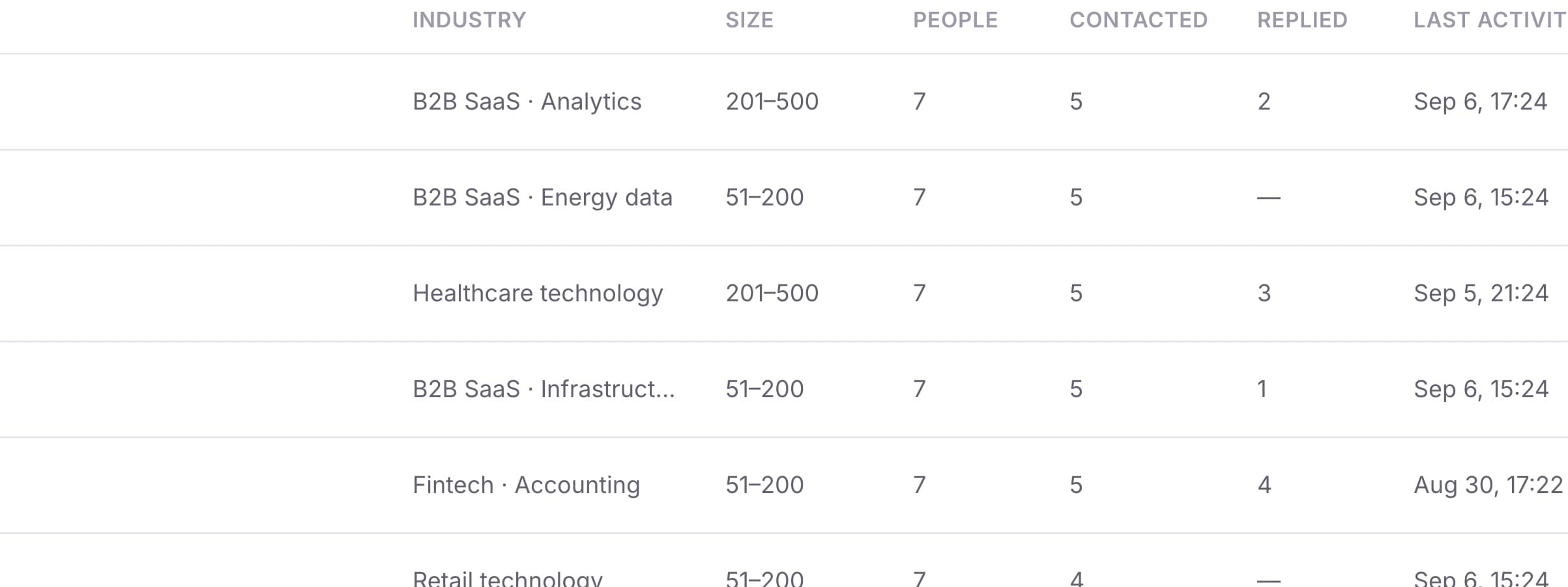
| Column | What it tells you |
|---|---|
| Company | Its name, its logo where we can find one, and its web address |
| Industry · Size | What we know about the business |
| People | How many people from there you hold |
| Contacted · Replied | How many you have written to, and how many wrote back |
| Last activity | The last time anything happened with anyone there |
Contacted and Replied are the two worth scanning. Twelve people at a company and nobody contacted is an opportunity; twelve contacted and nobody replying is a message that is not working.
What is inside one
The people you hold from that company, with the same statuses they carry in Leads — and the firmographics we could verify: industry, size, headquarters, web address, and funding where it is public.
Nothing is promised. For plenty of companies we have a name and the people, and that is it.
Why a company can look thin
Two things make a company's row sparse, and they are different problems.
- We hold one person there. Nothing to group; the company is really just that person's employer.
- We could not verify the business itself. Common for private companies, holding structures and anything renamed recently.
The second is the one that makes a row look wrong when it is merely unknown.