
Reading a match
What the reason line is for, which fields are always there, and the two signals people routinely over-read.
Last reviewed September 8, 2026
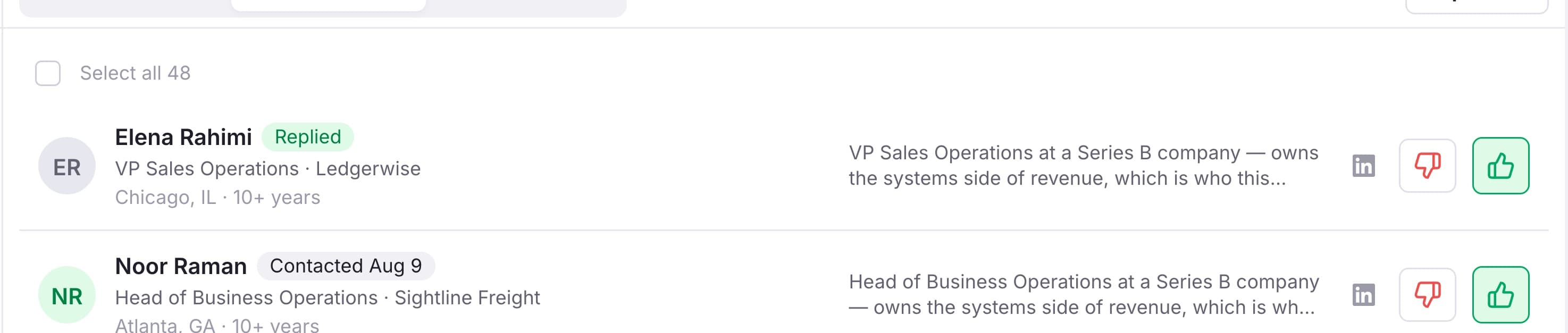
Every row comes with the reason it matched. That line is the product's answer to the question a filter never has to face: why this person?
What the reason line is
One sentence, written per person against your description — what about them satisfies what you asked for. Not a score, not a percentage, and not a template with the company name slotted in.
It is worth reading before you approve anyone, for a reason that has nothing to do with trust: it tells you whether your description landed. Five reasons that all cite the same weak signal mean the brief was thin, not that the market is.
What is on a lead, and what is not
| Always | Usually | Sometimes |
|---|---|---|
| Name, role, company | Location, seniority, time in the seat | An email address |
| The reason it matched | Company size and industry | Previous role, education, skills |
| A LinkedIn profile | Hiring activity at the company | Phone |
Nothing is promised. For plenty of people we have a name, a role and a profile, and that is the honest extent of it — a field left empty means we could not verify it, not that it does not exist.
Time in the seat is not time at the company
Someone promoted internally last month has years at the company and weeks in the role. The two answer different questions: how well they know the place, versus how much room they have to change how it buys. We show time in the current role, because that is the one that predicts whether a new tool is on the table.
Hiring activity, read carefully
Open roles at a company are a signal about the company, not about the person. A company hiring six sales people is expanding a motion; that says nothing about whether the person you are looking at owns it.
Useful as context in a first line. Weak as a reason to contact somebody.