
Describing who you want
The description is the product: what to put in a brief, what to leave out, and why exclusions carry as much weight as inclusions.
Last reviewed September 8, 2026
The description is the product. Everything else — ranking, the reason per row, what gets excluded — is downstream of how well you said what you wanted.
Write responsibilities, not just titles
A title is a label a company chose; a responsibility is what the person actually owns. "Head of RevOps" misses the VP of Sales Operations who does the same job at a company that never made the title.
Say what they own, then let the titles fall out of it.
Four things worth putting in
| Element | Weak | Strong |
|---|---|---|
| The person | "Marketing manager" | "Owns demand generation and reports to the CMO" |
| The company | "Tech companies" | "US B2B SaaS, 50–300 employees" |
| A signal | — | "Raised a Series B in the last 18 months" |
| A boundary | — | "Not agencies, not consultancies" |
The signal is what makes a list feel current rather than scraped, and the boundary is usually what removes the matches you would otherwise reject one by one.
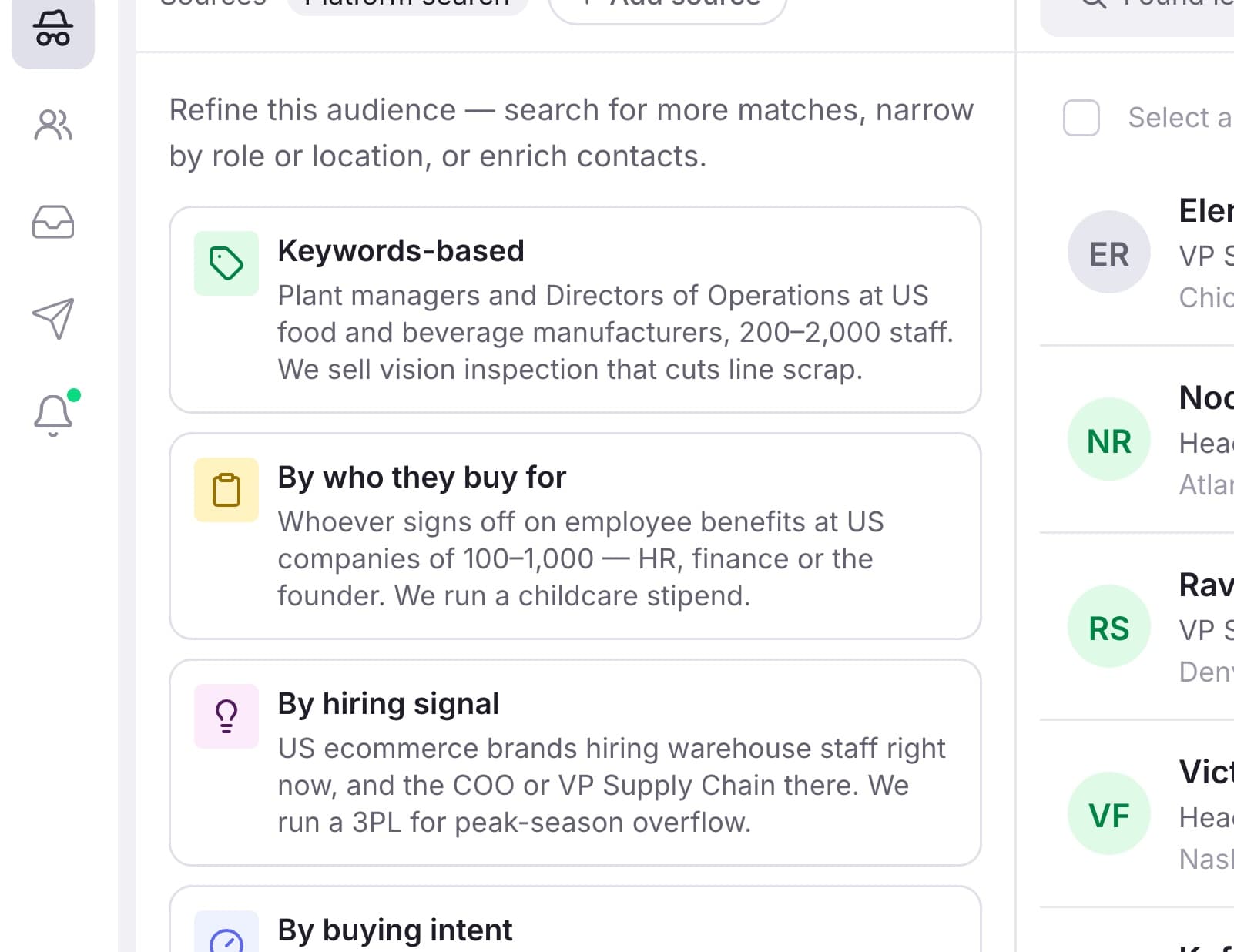
Say what you do not want
Exclusions carry as much weight as inclusions and are easier to write: you already know what keeps showing up that you do not want. Competitors, your own customers, agencies, staffing firms, companies below a size where the problem does not exist yet.
One search, one shape
A brief that asks for two different populations — "heads of RevOps, or founders at agencies" — produces a list that is bad at both. Two agents, two descriptions, two lists. They cost the same as one search each, and each one can be re-run and narrowed on its own terms.
Re-run instead of rewriting
An agent keeps its description. Re-running it brings back what is new since last time, which is the right move when the market moves rather than your definition. Rewrite the description when you were wrong about who you wanted; re-run when you were right and want the next batch.